
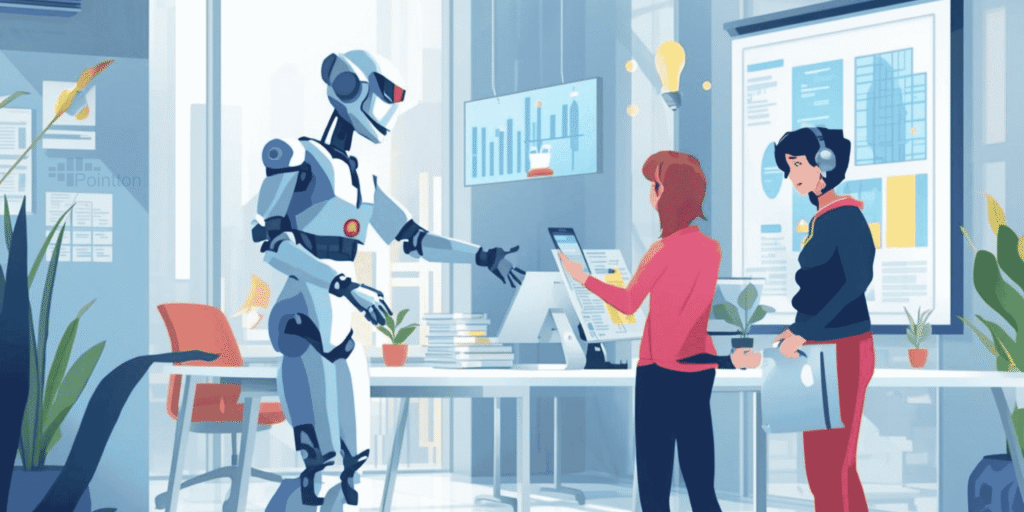
Will AI replace humans in the workplace or will it empower them? That is the agelong question everyone has been asking since AI gained traction among everyday users. The story about artificial intelligence at work often swings between two extremes. On one side, people see a bright future of easier productivity, and on the other, they fear job loss and chaos. Both extremes overlook a more complex and powerful reality emerging in innovative organizations.
As AI rapidly permeates the workplace, early fears of an all-automated workforce are giving way to a new reality, one where humans and AI work side by side and not as competitors. Within this lies a lot of value that can be tapped when employees leverage AI efficiently in their daily work. Recent studies by Pointton have revealed that companies who deploy AI to support their employees’ work have been found to outperform those pursuing automation-only initiatives by 25%. This performance comes from leveraging each side’s strengths, such as AI’s speed and data-crunching abilities to amplify human judgment, creativity and empathy. The shift underway is not about competing with employees; it’s about redesigning roles and workflows so that humans and AI can collaborate seamlessly.
Understanding the Core Principles of Human and AI Collaboration
Human and AI collaboration is evolving beyond simple tool-based interaction into true partnerships founded on mutual understanding and shared goals. At the core of effective collaboration lies mutual respect and acknowledging the complementary nature of humans and AI capabilities. When humans view AI systems as teammates rather than just tools or their future replacement, the foundation for meaningful collaboration emerges. This shift in perspective enables both parties to leverage their unique strengths while compensating for each other’s limitations.
While AI excels at processing vast amounts of data, identifying patterns, and maintaining consistency in repetitive tasks, humans contribute creativity, judgement, emotional intelligence, and unique understanding of stakeholders and internal processes. The relationship between humans and AI is dynamic, with both parties adapting and improving through interaction. AI systems also learn from human feedback and behavioral patterns, while humans develop new skills and ways of thinking through their work with AI. This creates a cycle of improvement and innovation.
To foster this collaboration between humans and AI, communication and transparency is an essential bridge; a ground where AI systems can clearly explain their decision-making processes and humans can effectively communicate their needs and feedback. This helps in trust building and enables more effective collaboration which is needed in the ongoing learning and adaptation. By understanding AI’s communication style better, humans can adapt the way they interact with AI, and in the same way, AI systems continue to learn and adjust their interactions based on changing circumstances and requirements.
What do organizations stand to gain when humans and AI agents collaborate?
Organizations that create workflows and the enabling environment for human and AI collaboration gain many benefits which go beyond cost-saving.
1. Faster and Data-Drive Decisions
AI rapidly analyzes vast datasets; uncovering patterns and trends that may go unnoticed by humans. When paired with experienced human judgment, these insights enable faster, more informed decisions. For example, a supply chain manager can leverage AI to anticipate potential disruptions and respond immediately; rerouting shipments or adjusting inventory in real time. What once required days of manual analysis can now be accomplished in a matter of hours.
2. Enhanced Employee Experience and Value
Automating repetitive tasks enhances employee experience by freeing the capacity of professionals to focus on higher-value work. This shift drives stronger engagement, improves job satisfaction, and supports retention, mainly because employees feel more valued when their contributions reflect their unique strengths and they recognized for insights and creativity rather than routine output. By reducing low-value tasks, organizations create a more meaningful work environment where employees can contribute at their best and find greater purpose in what they do.
3. Faster Innovation Cycles
AI accelerates innovation by rapidly testing ideas, simulating scenarios, and analyzing market responses. It not only shortens the path from concept to insight but also helps identify emerging trends. When paired with human creativity and strategic vision, this capability transforms how teams innovate; hence, more ideas can be explored in less time, with quicker, lower-cost failures that lead to faster learning. Iteration becomes continuous; enabling teams to move swiftly toward breakthrough solutions. In this setup, AI acts as a true digital colleague; handling complex analysis and computation and freeing people to focus on envisioning, judgment, and bold thinking.
4. Sustainable Competitive Advantage
True advantage doesn’t come from simply adopting AI, but from how effectively humans and AI collaborate. For organizations that embed this partnership into their core operations, they are able to build capabilities that competitors struggle to replicate. By combining human creativity, judgment, and context with the speed, scale, and pattern recognition of digital intelligence, these organizations make better and faster decisions, and they adapt more quickly to change. Over time, this creates a reinforcing cycle where improved outcomes generate better data, which sharpens both AI systems and human expertise.
This translates into tangible organizational impact in several areas, some of which include faster product development cycles, more accurate forecasting, and smarter resource allocation. Customer experience becomes more personalized, responsive and more meaningful; hence, improving retention and lifetime value. Operationally, teams reduce inefficiencies and cost while improving quality. Strategically, leaders gain clearer insights and can act with greater confidence in uncertain environments.
Where performance improvements build on themselves across functions, the organization doesn’t just perform better in isolated areas; it becomes structurally more agile, efficient, and resilient than its competitors over time.
What’s Next?
Start designing workflows where humans and AI agents collaborate rather than compete.
Realizing the benefits of human and AI collaboration requires intentional role design and workflow planning. Your organization must reimagine jobs and processes to determine where humans add value, where AI adds value, and how to build synergy between the two. It’s not a one-way street where AI completes all of its tasks and hands over to a human for review; instead, it is a very conversational collaboration where humans and AI keep interacting and collaborating on the body of work until the final piece is ready.
The future of human-AI collaboration stands at a transformative stage where the seamless integration of artificial and human intelligence promises to enhance how we work. The most significant outcomes are achieved when humans and smart machines work together, enhancing each other’s unique strengths rather than competing against one another.
To champion effective human-AI collaboration, you must invest in your people as much as you invest in technology; hence, reskilling and upskilling your workforce takes the center stage. While ushering the employees into a world where AI becomes their new efficiency companion, you should establish an environment which encourages them to freely and responsibly use AI. By doing so, you are enabling seamless interaction and collaboration; a workplace ecosystem where humans and AI continuously learn from each other and adapt.
The result is a workforce that’s more productive, innovative, capable of addressing increasingly complex challenges and a workforce that feels empowered rather than threatened by technology. The future belongs not to those who resist this change, but to those who thoughtfully integrate AI capabilities while preserving and enhancing the irreplaceable human elements that drive innovation and progress.